Keep a path back to the source
An extracted relationship is a lead into the archive. Its supporting conversation carries the wording and date needed to assess what the record actually establishes.
Case study 04 / Memory
Conversation analysis became a graph of projects, ideas and dated relationships. FindThat and Same-Page address two neighboring needs: recovering one detail and carrying relevant context into the next task.
Follow a connection back to its source.Explore a small, inspectable memory.A self-contained sample of reviewed technical knowledge.01The starting point
A good summary explains one session. It takes more work to find the decision buried in another session, or understand how the same project changed over time. I extended PanelForge’s analysis with entities, relationships and events that connect those separate records.
Extraction brings its own problems. Generic facts can crowd out useful context, aliases can become duplicate entities and a cleanup process can make a mistaken edit. I worked on relevance, canonical resolution and a reasoned history of graph actions so those decisions can be inspected.
The archive also supports smaller workflows. FindThat recovers a specific command, error or edit with its source. Same-Page loads a previous analysis as background while keeping the new request in charge of the work.
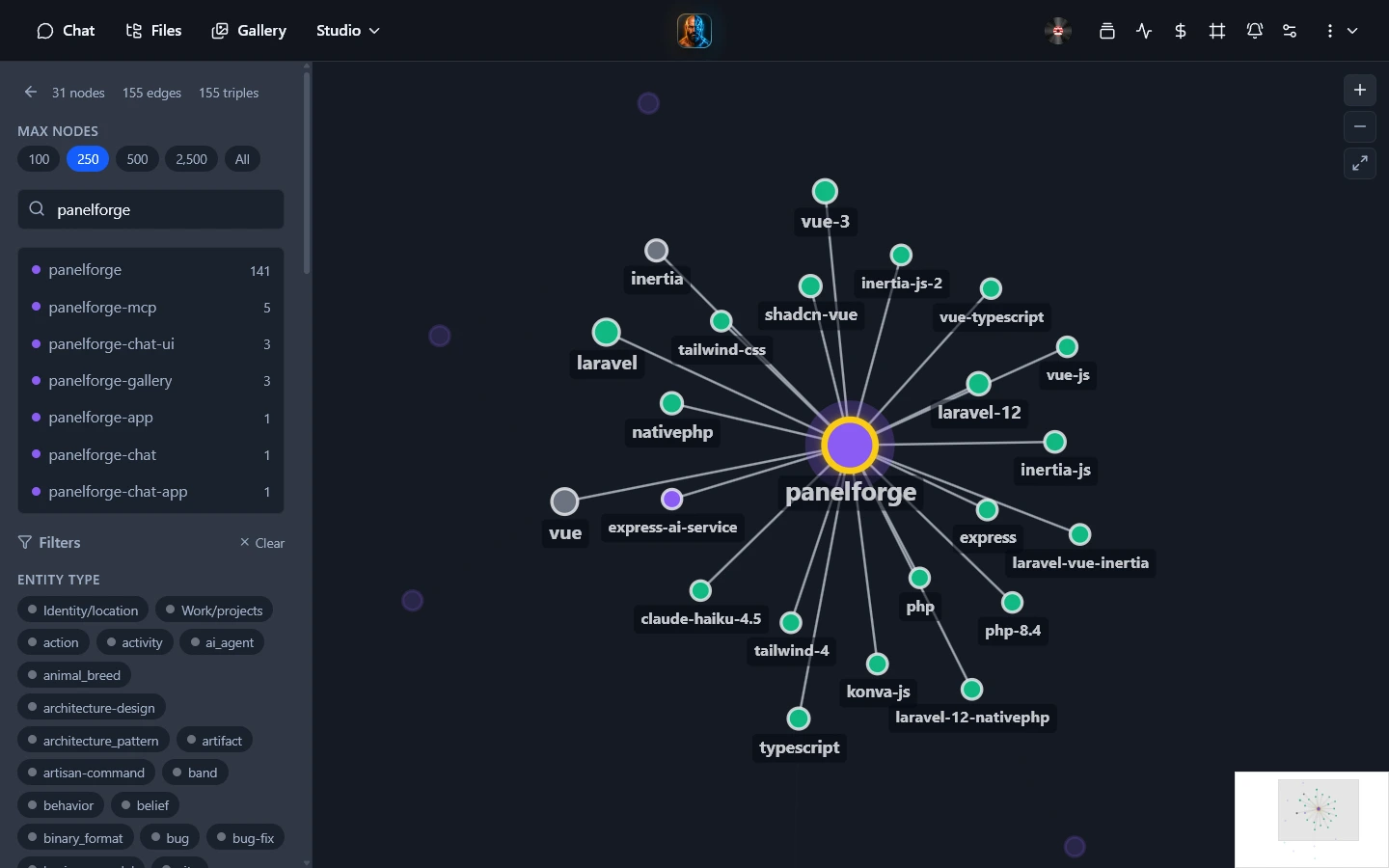
Actual graph interface with selected public-safe project knowledge. Historical names and aliases are extracted records, rather than a current architecture inventory.Select the image to explore the details.
02What the workflow looks like
FindThat selects a message, tool-call or file-modification index according to the clue, then retrieves the supporting record. The result includes the useful detail and enough provenance to check it.
The graph brings entities and extracted relationships together. Search and predicate filters narrow the view; selecting an entity focuses its nearby connections. Source conversations explain where a relationship came from.
A scoped candidate catalog supports canonical entity reuse. Curation actions can preserve reasons and before-states, with inverse actions where supported. The implementation retains a distinction between an extracted fact and a reviewed one.
Same-Page loads previous analysis for a new task. A maintained profile can supply approved stable context to supported fresh engine sessions, with opt-in and revision history. Private profile content is excluded from this portfolio.
Recorded in the product
Actual PanelForge interface · inspected project/software labels · edited recording
Search narrows the actual graph to PanelForge, a predicate filter selects build relationships, and selecting the project brings nearby software into focus. Zoom and fit change the view. Cuts shorten stationary pauses.
03Design + engineering
An extracted relationship is a lead into the archive. Its supporting conversation carries the wording and date needed to assess what the record actually establishes.
Observed skipped lookups and duplicate entities led to an explicit grounded-analysis flow and batch resolution. Similar wording needs evidence before it becomes one canonical entity.
Curation records action rows and before-state snapshots. A supported inverse action creates more review history instead of making the correction disappear.
Explore the individual features
04Selected release history
These are historical changes recorded in repository tags. The capture and current-state notes below describe what is being shown here.
The release added subject-predicate-object extraction and events, questions, decisions and beliefs to the analysis pipeline and conversation details.
web-v6.98.0About the material shown here
Selected screenshots and edited recordings accompany changes checked against repository history through October 2026.
The graph recording is a fresh capture of the real PanelForge interface, filtered to public-safe project and software relationships. Search, predicate filtering, focus, zoom and fit were exercised. Extracted aliases and historical technology names remain visible; the graph is not a verified inventory of today’s architecture.
Graph extraction is supported by the checked web-v6.98.0 tag from 13 March 2026. August source commits added the grounded loop and batch resolution; September and October records explain review and curation work. Current source also defines FindThat, Same-Page and profile history. These source checks do not establish every workflow’s current production enablement.
Product imagery uses selected material prepared for this portfolio. Recordings show the interface in use. Architecture graphics describe system relationships and do not show live service availability.