Share the client contract
The engines use the same stream format so clients can present text, tool activity and completion consistently. Runtime-specific session handling stays in the engine.
Case study 02 / Connected agents
Three agent engines and Apple clients, with a common way to show the work. The system accounts for long turns, interruptions and disconnected screens.
One recorded run23characters received2,632characters recoveredReplay the disconnect Controlled Claude Engine run · the same process kept working.01The starting point
An agent can spend a while reading files and using tools. During that time, a browser can disconnect and a person can move to another device. A partial transcript does not tell them whether the task is still running or has finished.
I built engine services around Claude, Codex and OpenCode, with a common stream for the web and Apple clients to read. Each engine handles its own upstream runtime and session behaviour.
A question can leave the terminal
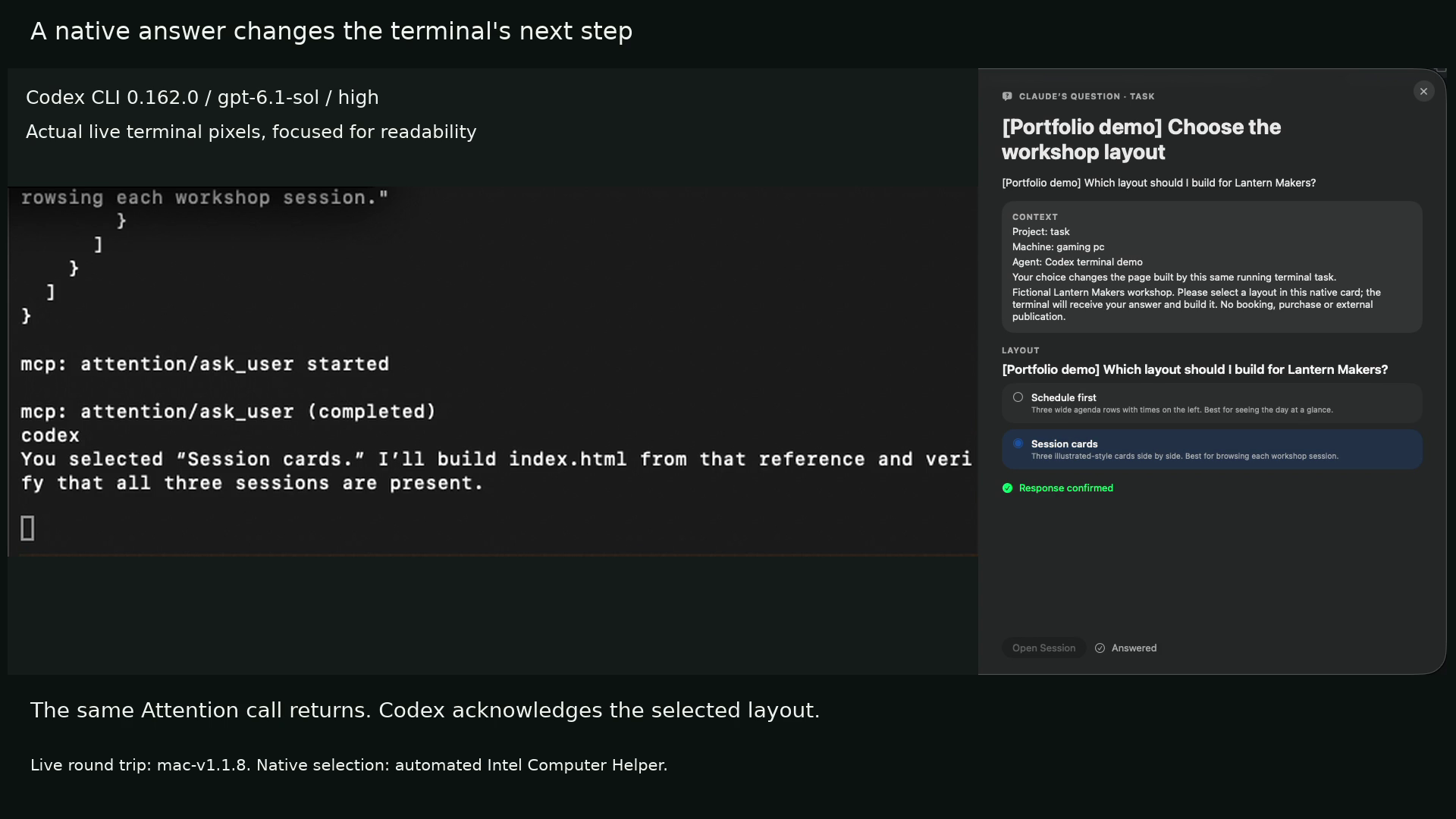
Codex needs a layout choice. Attention brings the question into the Mac app, returns the selected answer to the waiting terminal, and the same task builds the page.
The recorded choiceSession cardsWatch the terminal-to-Mac round tripThe result is a responsive workshop page with three session cards.
Actual shared Attention MCP and released Mac app. Automated native choice; fictional workshop. The resulting file is available to download.
02What the workflow looks like
Claude, Codex and OpenCode connect through a common client stream format. Engine adapters handle the different upstream protocols; the shared interface does not merge the models’ conversation state.
Text and tool activity arrive as stream events. Queue and injection paths let a follow-up enter a running turn deliberately.
A stored-result path lets the client retrieve a completed turn and reconcile its partial transcript after a browser or proxy connection breaks. An engine restart has separate recovery rules.
The Apple client holds durable question cards from agents. An answer or decline returns to the waiting session through the attention and relay services.
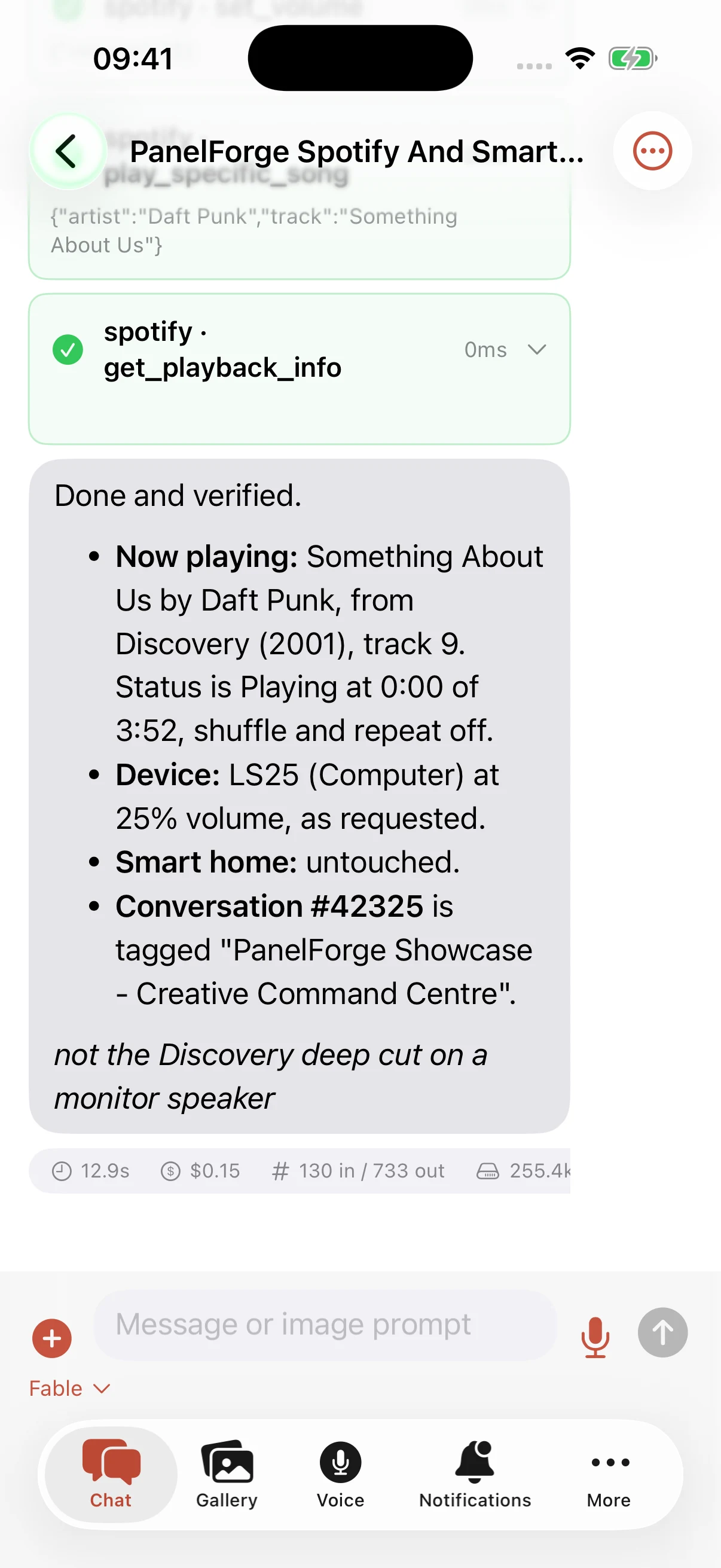
Another screen for the same work
The Apple app gives conversations their own interface on iPhone and iPad. This separate capture opens a saved conversation and its provider and model menus in the native app on an iPhone Simulator.
Recorded in the product
Native iPhone app · iPhone Simulator · saved conversation · edited recording
A saved showcase conversation opens in the native client. Chat options reveal the provider and model controls; the menus open, then the recording returns to the chat without changing the selection. The local workspace path is hidden. Cuts remove waiting time.
03Design + engineering
The engines use the same stream format so clients can present text, tool activity and completion consistently. Runtime-specific session handling stays in the engine.
Claude uses its agent SDK; Codex uses the bidirectional app-server protocol for streaming, steering and forks; OpenCode uses its typed client. A shared interface still needs three distinct integrations.
A pause can mean a tool is starting or a result is taking time. The Codex watchdog now checks upstream liveness before deciding that a quiet turn has failed.
Explore the individual features
A schedule across two processes
Claude Code supplies the native schedule. I built the engine-side checks and session bookkeeping around it. This recorded run resumes the same session in a new CLI process and receives the scheduled response without another prompt.
Process A
The original CLI created one non-recurring session cron.
Process A exited
Its process was gone before the session resumed.
Process B
A different CLI resumed it without another query.
Autonomous response
The scheduled response matched the fixed text requested.
Fixed response matched
The saved result records the match. Prompt and response text are omitted.One observed answer arrived +2.40 seconds from the engine mirror’s predicted fire time. This is one recorded check, not a benchmark or timing guarantee.
This check covers CLI session restoration and one scheduled answer. Engine restart, delivery callbacks and production health were outside the test.
These are fixed synthetic transcripts processed by the unchanged engine classifier. They are separate from the real CLI test above.
| Saved situation | Classifier result |
|---|---|
| Future one-shot | Eligible to restore |
| One-shot whose fire time passed | Dropped |
| Recurring job at seven days old | Expired |
A missed one-shot is dropped; this mirror does not promise catch-up. The seven-day recurring limit is its default. These examples do not establish every scheduling boundary in the native CLI.
The actual SDK and CLI ran in an isolated test. One explicit arming query created one non-durable, non-recurring cron. After that CLI closed, a different CLI resumed the same session with no query and no available tools. “Process A” and “Process B” distinguish those recorded processes; actual identifiers are omitted.
The timeline is a projection of recorded events, not a chat recreation or a live scheduler. The fixed-response match is a comparison of the actual saved result; its raw text is omitted.
2 SDK product interactionsInitial arming and autonomous answer. SDK-reported num_turns was 2 and 1; these are not provider inference or billing counts.
49 unique original tests passed25 classifier tests and 24 mocked component tests. Separate from the 16 synthetic cases and this live CLI proof.
My engine mirrors schedule eligibility from transcripts, restores the pinned session state and coordinates warming the session without a new prompt. The component tests isolate those responsibilities with mocked SDK, Redis and HTTP services.
No real Claude Engine restart, armed-session record, Redis outbox, PanelForge callback or HTTP warm route was exercised. The current CLI’s full expression, timezone and expiry behavior was not verified by this one-shot run.
Engine source v6.17.0 · SDK 0.2.164 · CLI 2.1.292. The mirror’s source comment references CLI 2.1.287; this recorded one-shot used 2.1.292.
04Selected release history
These are historical changes recorded in repository tags. The capture and current-state notes below describe what is being shown here.
Claude Engine reached its stable release, followed by a protocol and package refactor in v2.0.0.
v1.0.0OpenCode joined Claude and Codex through the common streaming path.
web-v7.91.0The iOS client added voice interruption recovery, standby and spoken questions after its first TestFlight release.
ios-v1.4.0Claude Engine gained a disconnected-result outbox and an ordered recovery timeline for interrupted client streams.
v6.13.0Claude Engine reconstructed eligible session crons from transcripts and restored their residency bookkeeping, so a resumed CLI could remain available for its scheduled work.
v6.14.5Restoration used the CLI’s configured time zone when predicting cron times, keeping engine bookkeeping aligned with the scheduler.
v6.14.6Codex Engine added bounded liveness probing so silence alone would not interrupt a legitimate turn.
v0.6.23Queue and injection steering gave follow-ups an explicit route into ongoing work.
v6.15.0About the material shown here
Selected screenshots and edited recordings accompany changes checked against repository history through October 2026.
The engines connect the web and Apple clients to three different agent runtimes. The shared interface gives each conversation the same place for text and tool activity. The Recovery Lab also documents a controlled run of the actual Claude Engine: after a browser disconnect, the same engine process completed the turn and its original result endpoint returned the stored answer twice. The run used a fictional text-only task and did not test process restarts, tool approvals or production client reconciliation. A separate SDK/CLI test stopped the original process, resumed the same session in a new process without another query, and received its scheduled response. The engine’s mirror agreed with that one firing time; the live run did not exercise engine startup or delivery callbacks.
Claude Engine’s first tag dates to February 2026. Codex and OpenCode followed in May; the iOS client reached TestFlight in July. October patches v6.14.5 and v6.14.6 record session-cron bookkeeping and its time-zone correction; v6.16.1 aligned the verification script with the engine’s configured CLI. The 15 October source proof keeps offline classification, mocked components and the real CLI run separate.
Product imagery uses selected material prepared for this portfolio. Recordings show the interface in use. Architecture graphics describe system relationships and do not show live service availability.