Send the page to the session that owns it.
The problem
Several sessions can share one browser. Without ownership, a page opened for one task can be mistaken for another session’s work.
A recorded browser handoff
Same page.
Different tab owners.
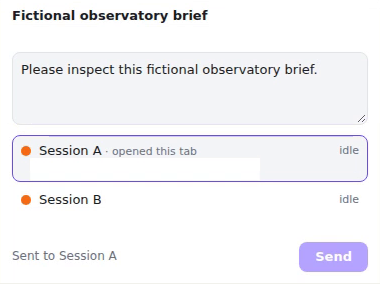
Two tabs opened the same fictional brief. The extension selected Session A, the owner stored for the first tab. Sending it produced one request addressed to Session A.
Actual ownership hook, Chrome extension and bridge in an isolated test. The session endpoint was a fixture; no agent read the page or replied.
| Tab | Page address | Stored owner | Result |
|---|---|---|---|
| Tab A | Same address | Session A | Selected and sent |
| Tab B | Same address | Session B | Not sent |
One request · Session ATab A’s browser identifiers retained.
The matching address did not choose the destination. The popup used the owner saved for the selected tab; the bridge routed that selected target.
Watch the recorded handoff
- Two tabs show the same fictional brief, grouped under Session A and Session B.
- The real extension popup opens on Tab A and selects Session A, marked “opened this tab”.
- Send produces one request to the fixture endpoint. The popup confirms “Sent to Session A”. No agent reads or answers the page.
Source and test boundaries
Unchanged Metacodex v1.0.6 ownership hook, extension popup and bridge, checked on 15 October 2026 in Chrome for Testing 156.0.8078.4. The popup was a genuine browser action popup, not an extension page opened as a tab.
The original hook received synthetic tool events around real fixture-tab creation. The isolated browser had two synthetic session owners. Fleet discovery and terminal metadata were replaced with empty fixture results; infrastructure subprocesses were blocked. A local fake Unix app-server supplied the two sessions and recorded the request.
The actual popup selected the stored owner and posted the chosen tab. The actual bridge validated the selected target, then sent one turn/start addressed to Session A. This is a request for a new turn, not an injected continuation of running inference. The bridge does not independently read browser ownership storage.
No real Codex CLI, model, provider, page-reading tool or agent reply ran. Real session discovery, cross-machine delivery and downstream page-tool selection were not tested.
The film retains original frames from 1.00 to 9.40 seconds, with no internal cuts or held ending. The popup still is an exact crop of the redacted film’s frame at 8.10 seconds, corresponding to 9.10 seconds in the original. Only endpoint and machine lines are masked; no screenshot pixels were regenerated.
Read the concise execution receiptWhat this makes possible
I extended Chrome tab grouping into a bridge that associates pages with agent sessions and sends a selected tab back with optional instructions.
Source information sheet
Evidence, implementation & history Implementation inspected
What I checked
Unchanged Metacodex v1.0.6 hook, extension popup and bridge exercised with two same-URL fixture tabs and synthetic sessions. One request reached a fake local app-server; no model or agent ran. October rollout records remain historical; current availability on individual machines was not checked.
Research cut: 15 October 2026. Source areas below are from metaclaude and metacodex. Private conversation references are retained in the research ledger and are not published here.
Implementation decisions
Session-colored groups and per-session tab ownership make agent-opened pages identifiable. The extension’s toolbar can send a chosen page to its session, including an optional prompt.
The bridge was developed for Claude and then Codex. The archived October rollout records installation on multiple machines; that history does not establish that every host is currently enrolled.
A path through the feature
- Identify the owning session
Use the tab group and ownership information before acting on a shared browser page.
- Send a specific page
Choose the tab and, if useful, attach a short instruction for its session.
Source areas
metaclaude/chrome/tab-groups-extension/metaclaude/chrome/metacodex/chrome/metacodex/bin/chrome-session-tabs.mjsmetacodex/bin/chrome-tab-bridge.py
The saved check uses the unchanged ownership hook, genuine extension action popup and actual bridge with two same-URL fixture tabs. Synthetic tool events, empty fleet and terminal metadata, and a fake local app-server isolate the request. One turn/start addresses the selected owner; no agent read the page or replied.
Recorded history
Dates describe the researched record, rather than today’s deployment.
Building browser tab groups for coding sessions
From tab groups to a browser-to-agent bridge
Rolling out Codex browser tab groups